 Helpdesk
+31 76 578 09 96
Helpdesk
+31 76 578 09 96
 Mail us at

Integrating Functional Safety & Cybersecurity in a Single Workflow
Audit-ready evidence with Ansys Medini Analyze
Overview
As systems become more software-driven, connected, and cross-disciplinary, it’s getting harder to keep functional safety and cybersecurity aligned—without creating gaps, contradictions, or rework.
In this session, our Application Engineer Vrushab Neelgundmath will demonstrate how a model-based, integrated approach enables engineering teams build consistent, traceable, and audit-ready evidence across safety and cybersecurity activities—using Ansys Medini Analyze.
What You’ll Learn
- To integrate Functional Safety, SOTIF, and Cybersecurity in a single, structured workflow
- To maintain consistency across safety and cyber analyses to reduce contradictions and rework
- To establish end-to-end traceability from requirements → hazards/threats → analyses → evidence
- To connect and manage core assessments such as HARA, FTA, FMEDA, and threat analysis
- To identify safety and cybersecurity risks earlier in the lifecycle
- To support compliance activities for standards such as ISO 26262, IEC 61508, and ISO 21434
- To improve governance through clear planning, execution, and monitoring of safety activities (DSM-style)
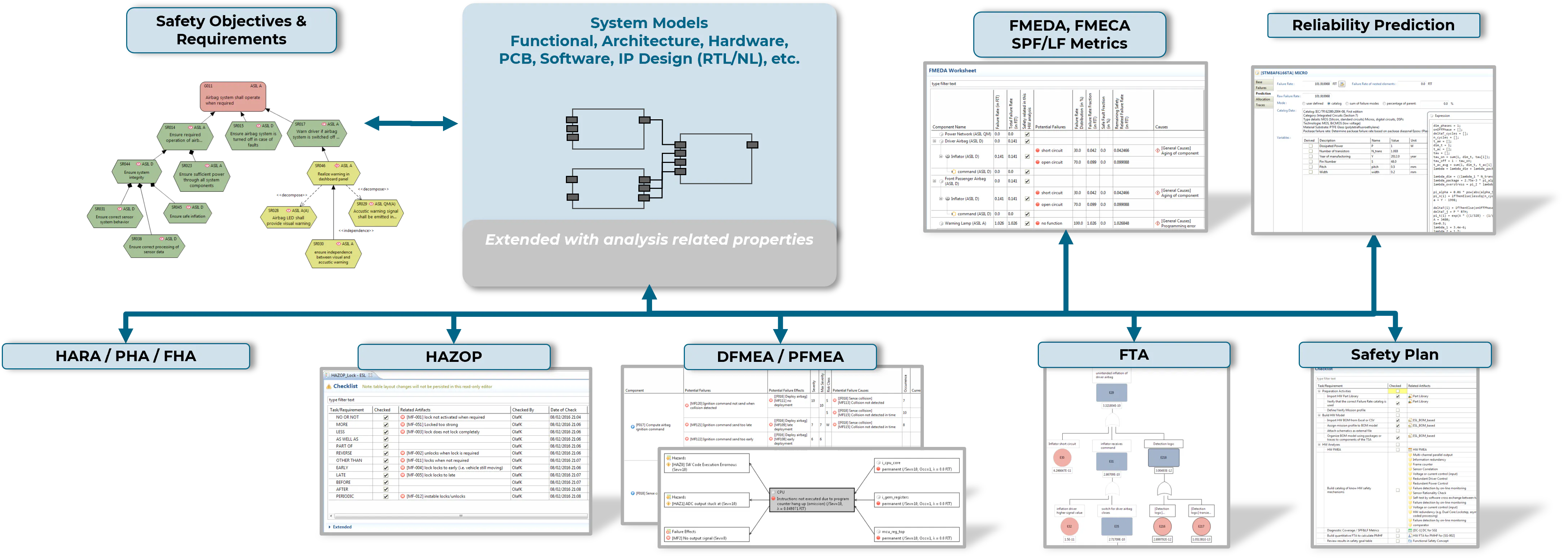
Image: Model-based traceability in Ansys Medini Analyze—linking requirements, hazards, FMEA/FTA, and reliability into one workflow.
Guest Speaker Highlight — BRACE Automotive
A key highlight of this webinar is a guest presentation by Avinash Varadarajan, Business Manager at BRACE Automotive, showcasing their “Silicon to Systems” approach.
The presentation will showcase:
- How they support PCB builders and chip manufacturers with end-to-end lifecycle expertise
- Practical safety-analysis workflows using Medini Analyze
- Enabling safe, secure, and sustainable innovation for next-generation mobility
- How safety and cybersecurity considerations connect from semiconductor level to system level
- Practical examples of structuring analyses for traceability and consistency across work products
