 Helpdesk
+31 76 578 09 96
Helpdesk
+31 76 578 09 96
 Mail us at

Solving Material-Flow Challenges in Food Processing Equipment
Understanding the Challenges in Food Material Handling
Food processing equipment manufacturers operate in an environment where material behaviour is intrinsically unpredictable. Grains, powders, seeds, and semi-moist or sticky materials each introduce unique flow behaviours that make the design of reliable equipment increasingly complex. Unlike liquids or solids, granular materials exhibit discontinuous, irregular and sometimes chaotic movement, causing unexpected load patterns, accumulation zones, and variable flow rates.
A major source of difficulty is the highly heterogeneous nature of food materials. Differences in particle size, moisture content, surface roughness, brittleness and cohesiveness create conditions where equipment performance can deviate drastically from expectations. For example, powders may fluidize, clump or segregate depending on humidity, vibration or hopper geometry, while fragile materials such as nuts or vegetables may fracture or bruise when subjected to unexpected impact forces.
Flow disruptions such as bridging, rat-holing, funnel flow, or erratic discharge patterns are among the most critical operational challenges. These flow instabilities cause stoppages, cleaning downtime, product waste, and in some cases hygiene risks when stagnant zones become contamination points. In equipment such as screw conveyors, mixers, dryers or coating systems, even small variations in particle interactions can lead to considerable inefficiencies.
Moisture content is a particularly important factor in the food industry. Sticky materials—like dough fragments, sugar-rich mixes or damp grains—can adhere to equipment walls, reducing flow capacity and increasing power demands. Over time, these accumulations contribute to wear, necessitate frequent shutdowns for cleaning and interfere with food safety requirements.
Traditional engineering methods such as CFD or FEA operate under continuum assumptions. They offer valuable insights into macro-scale phenomena but cannot accurately model micro-scale particle interactions, frictional contacts, cohesive forces, or dynamic segregation patterns. As a result, problems are often detected late in the design process, requiring costly prototype iterations and redesigns.
Using Particle-Scale Simulation to Improve Equipment Design
The Discrete Element Method (DEM) enables engineers to simulate the behaviour of individual particles, capturing the physical interactions that drive flow behaviour, product transport, and mechanical loads on equipment. Rather than approximating food materials as a uniform mass, DEM models each particle’s trajectory, rotation, contact forces and shape of the particle. This allows engineers to observe phenomena that would otherwise remain invisible until late-stage prototyping.
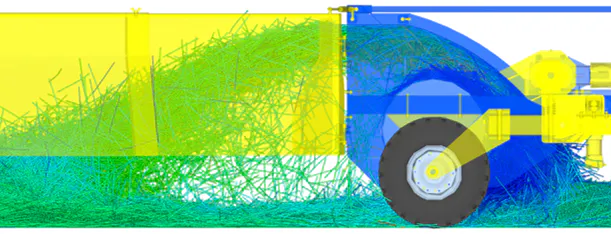
In practical terms, DEM allows for detailed evaluation of material flow through screw conveyors, hoppers, belt systems, rotary drums, blenders and fluidization zones. Engineers can analyse how design parameters—such as pitch angle, blade geometry, hopper outlet size, or drum rotational speed—influence flow uniformity, particle residence time and equipment wear. This granular understanding makes it possible to make targeted design changes that improve throughput and reduce downtime.
Another significant benefit of DEM is its ability to model cohesive or wet materials, which are particularly prevalent in the food processing industry. In these cases, adhesion forces can be simulated to allow realistic prediction of clumping, buildup or sticking behaviour. This insight is essential for designing hygienic equipment where product residue must be minimized for food safety compliance.
DEM is also valuable for analyzing and reducing product damage. By tracking impact forces and shear stresses on individual particles, engineers can determine where fragile materials—such as cereal flakes, legumes or soft vegetables—are most at risk of breaking or bruising. Design optimizations can then focus on smoother transitions, fewer impact points or more suitable material velocities.
With the ability to capture particle-scale physics, DEM transforms the design process from reactive correction to proactive prevention. Instead of relying on physical experimentation alone, engineers can explore design alternatives virtually, narrowing down the most promising geometries before constructing prototypes. This reduces development costs, increases engineering confidence and ultimately leads to more reliable, efficient and hygienic food-processing equipment.